


Dance Dialogues
Dance/NYC Fostering Connection in the Digital Realm
with Laurel Lawson and Ashley Ferro-Murray
In this edition of Dance Dialogues, we share a conversation between two visionary leaders at the intersection of dance, technology, and advocacy, Laurel Lawson and Ashley Ferro-Murray, Ph.D. Laurel is a transdisciplinary choreographer and artist-engineer whose innovative work spans both traditional choreography and novel ways of extending and creating art through technology and design. Ashley is the Program Director for the Arts at the Doris Duke Foundation, where she drives and oversees grantmaking and other efforts to advance the foundation’s support for performing artists. Their conversation explores how technology can be harnessed by artists and dance service organizations alike to foster equitable, inclusive, and pioneering futures. From increasing accessibility within the field to the ethical considerations of tech in art, they offer insightful perspectives on the role Dance/NYC and similar organizations can play in shaping the future of dance through technological innovation.
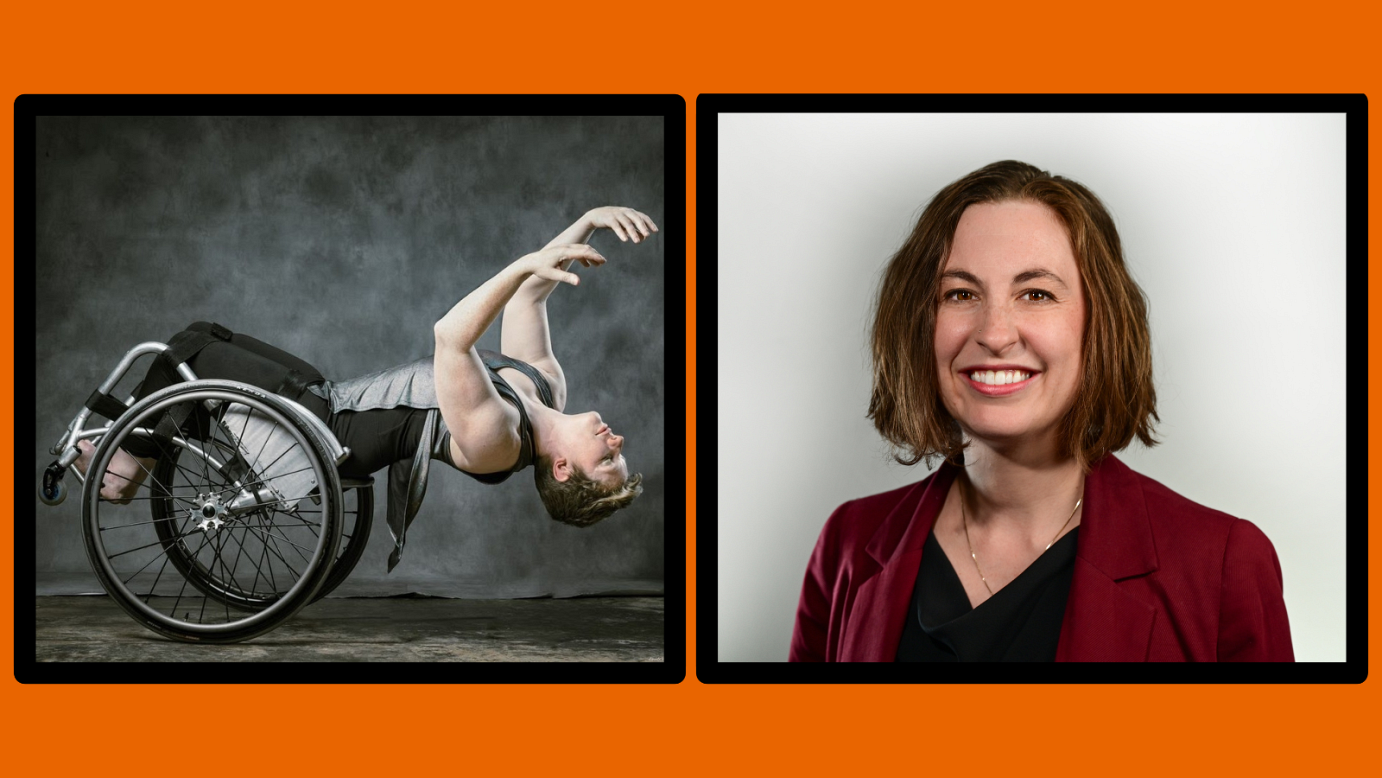
Pictured left: Laurel Lawson; Pictured right: Ashley Ferro-Murray
Laurel Lawson (LL): Hi, my name is Laurel Lawson; my pronouns are flexible. I am a choreographer and artist-engineer working across multiple domains, including conventional choreography, bodies on stage, and collaboration as a medium. I believe that 1 + 1 can equal 3, and sometimes 2 + 2 equals 5. I also work as a technologist and product architect, creating novel technology and imagining new tools and experiences that can be used for artistic and accessible, equitable experiences.
Ashley Ferro-Murray (AFM): Hello, Laurel. It's such a pleasure to be in conversation with you today. My name is Ashley Ferro-Murray, and my pronouns are she/her. I started as a dancer and choreographer and have been trying to hold close to those beginnings of late. I then trained as a scholar and historian of dance, thinking critically about the power structures and categories of technology that have been built through those mediums in the field of dance. That work led me to curatorial practice. I worked at the Curtis R. Priem Experimental Media and Performing Arts Center (EMPAC) for almost a decade as the dance and theater curator, running a commissioning and development residency program across dance and theater. I also collaborated closely with our departments of music, sound, and time-based visual arts. While there, I embodied the role of translator between a team of staff engineers and the artists who came to work with us. I've now taken on that work as the arts program director of the Doris Duke Foundation. I've been here for about a year, running an arts program that supports contemporary dance, theater, and jazz. I work across two strategy areas: one focuses on the creative conditions that artists need to thrive, and the other focuses on the intersection of technology and the performing arts.
AFM: I think technology is a really broad category, and I've held onto that broadness in my career because I believe it can serve our field. There are a lot of different ways in which service organizations like Dance/NYC might intersect with tech and use it to support the future of the field and the well-being of artists. First, I think access within performing arts communities is huge, and I mean this in two different ways: 1) using technology and developing technological platforms to increase disability access in our field, and 2) increasing access that field practitioners have to technology generally, learning how to use it and engage with it. When I say technology, I mean both production technologies like rigging, audio, and lighting infrastructures, and what I think of as emerging technologies—new systems like virtual reality platforms or Laurel's work with Audimance that might be applied to a specific dance performance. So those are kind of work-specific and presentation-specific contexts where I think a service organization might help the field. I think the ways Dance/NYC has historically used data are exciting, and that's one way to use technology in our field. Having more data about access to technology and how technologies are used to increase access is invaluable because it will help create a base for knowledge building. I also think the networking capacity of service organizations is huge, and that might be one way of supporting technological infrastructures in the field—for developing new works and also how artists and arts organizations support one another. Then, just generally, being a resource of knowledge for the field is essential. I've been thinking a lot lately about knowledge repositories or lending libraries of knowledge—somehow creating these different pockets where folks can learn how to apply various types of technologies, from using open-source artificial intelligence software for back-end administrative capacity or grant writing and reporting to creating new works. The broadness of technology, as I mentioned at the beginning, is something that I think will serve our field. When we get too attached to one definition of how technology will serve the future of the field or specific organizations, we limit ourselves to the possibilities of things emerging and building up later.
LL: Yeah, that's really great, Ashley. I think the broadness is actually necessary because this is the water we swim in. I think of dance service organizations as fundamentally information organizations. Our service orgs are in the business of distributing information to artists, gathering information from and about artists, and communicating that to other places in our business, political, and cultural ecosystems. So, any form of communications technology that speeds up or simplifies that flow of information is technology our service orgs need to be grounded in. Particularly as we're going through this real-time transformation of the administrative infrastructure of the field, it's necessary that all our administrative infrastructure moves towards using tools to make life easier and not harder. It's necessary for service orgs to have a concrete impact and communication with the artists they serve, which means meeting artists where they are. Today, for artists in digital space, it means having conversations about whose needs are being met, understanding audience segmentation, user flows, and tracking what information is coming in, where it's going, and what its impact is. So, all those things are fundamentally about knowledge and communication, and technology should be in service to communication.
AFM: I definitely only know Laurel because of Dance/NYC, but Laurel, you might not even know that! Yes, I knew Dance/NYC as a curator. I relied on and engaged with the organization. I was invited to be a speaker and participated in the "Dancers Are Necessary Workers" campaign during COVID as a panelist in one of those virtual conversations. My first time as a Dance/NYC panelist, I was having a conversation about the role of technology in the field, and Alice Sheppard was in the audience. We connected from there, and it was through Alice and Kinetic Light that I met Laurel. I had the amazing once-in-a-lifetime experience of getting to work with Laurel in residency when I was curator at EMPAC, and Kinetic Light came to do some post-production.
LL: Well, yeah, that work was around exploring different ways we could leverage existing tech to work with the way we were thinking about sound and video. That was also when we were seriously starting to work with live streaming. That was one of our first really highly produced live stream performances—a five-camera shoot, thanks to EMPAC. I also remember we had a conversation about what the audio experience of dance could be when you don't start from the assumption that dance is a visual art form. This was around the time Alice and I were working towards our language that dance is not a visual art form. What that audible experience could be, and we were just beginning that level of development with Wired. And, it seems like I was right—let's name it for the record—when was that?
AFM: Let's see, I met Alice probably in 2017, and you came to residency maybe in...
LL: 2017...
AFM: Maybe 2018?
LL: 2018 at the latest, it could have been 2017. It's been a short minute, you know, I won't call it a long minute.
AFM: It's been great conversations that have extended ever since then, right? It's been a constant get-to-know-you from there and dig deeper into the work.
LL: Yes, and what a gift to be in conversation across the years. The field of technology, even emerging tech, centered and born from dance, isn’t huge. So, a lot of us know each other. Some of the work I've been trying to do is about gathering people, having those conversations, and learning what we bring from the in-between, the inter, or the multi. With my little thought that dancers shouldn't have to be engineers to engage with innovation in technology, that all just keeps continuing. Of course, with Dance/NYC's work to engage with and support the world of disability art, and with the organization's work as a leader in accessibility and equity, we've had multiple engagements organizationally and at multiple levels. I think everybody's got my email at this point, yeah!
AFM: Yeah, it's like open source Laurel—open source Laurel for the dance community!
LL: Clone my repo!
AFM: I think the acknowledgment that dance as a discipline has much to give to engineering is another important one. The embodied knowledge one brings to the experience of moving, working with, and interfacing through various technical structures can help inform how we integrate these media into our society in the future. I believe the political and aesthetic frames that the dance field moves within should be at the heart of how we're defining technology for our society's futures. That's complicated, though. One of the things you and I have talked about a lot is the relationship between the dance field and for-profit industry—how to both be at the table of learning without providing free service while ensuring that dancers are compensated for their work in doing that labor.
LL: Understanding the necessity and centrality of artists as creators and innovators who walk into the unknown and bring something back to advance our collective understanding and cultural experience is crucial. This often contrasts with technology for profit. Technology is a lever; it increases the influence each person can have. But nothing happens from one person alone in practical terms—there's no single choreographer, engineer, developer, or designer. The magic lies in the team. Understanding the role of artists as cultural innovators in service to creation and community, wherever they find themselves and whatever sources they draw from, often contrasts with technology for profit. We must look at the goals of these technologies, how they are created, deployed, and scaled. What is the goal? What is the intention? What is the impact? Who is being affected? Where is the money going? Is profit being created? If so, what's being done with it? This leads us to the necessity of advocacy around artists not being fairly compensated. We could spend many hours talking about contracts and other subjects, but there's a lot.
Ashley Ferro-Murray
IG: @ashfms
Ashley Ferro-Murray is the program director for the arts at the Doris Duke Foundation, where she drives and oversees grantmaking and other efforts to advance the foundation’s support for performing artists. Prior to joining the Doris Duke Foundation, Ferro-Murray was the senior curator of theater and dance at The Curtis R. Priem Experimental Media and Performing Arts Center (EMPAC) at Rensselaer Polytechnic Institute. She earned a Bachelor of Arts degree from Cornell University and a Ph.D. from the University of California, Berkeley in performance studies with a designated emphasis on new media.
Laurel Lawson
IG : @worldsoflaurel
Laurel Lawson is a choreographic collaborator, dancer, designer, and engineer with Kinetic Light. She is the primary costume and makeup designer, and in collaboration with Top End’s Paul Schulte designed the wheelchairs that she and Alice use in performance, as well as contributing other visual and technical design. She is also the product designer and lead for Audimance, the company's app which revolutionizes audio description for non-visual audiences.
Beyond the studio, Laurel is the CTO and co-founder of CyCore Systems, a boutique engineering consultancy which specializes in solving novel, multi-realm problems of all sizes for a global clientele.