



Thursday, July 17, 2025
PANDA 2 | PAUL SINGH + JESSE ZARITT
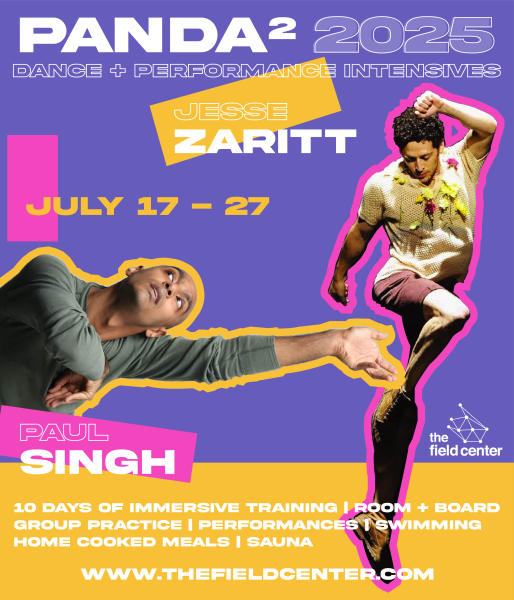
PANDA [Performance And New Dance Arrivals] are some of the longest programs offered at the Field Center and they are deep dives into living with one another as artists while training daily with established teachers in the field. Daily classes are punctuated by swims in the river, saunas, fresh food from our gardens, long naps in the library, field trips and performances at night.
JESSE ZARITT: No end of detail
During our time together, we will move through three different modes of study:
1. Studio Practice:
Sessions will begin with guided research practices that examine relationships between curiosity, desire, strength, organizations of effort/force and ideology/aesthetics: practices of critical physicality! Phrase-work will be shared as a portal to play. Choreographed material will act as a set of coordinates that anchor an exploration of exaggeration and sensation. We’ll fall into and out of lush, decadent movement experiences.
2. Drawing Lab
Sessions will engage drawing as a physical and visual practice linked to dreaming, drafting, and materializing futures. Elements of drawing such as line, tone, texture, edge, fluidity, atmosphere, and spatial planning will be collectively explored and discussed. By studying how drawing moves and movement draws, we will critically re-imagine how and what we observe, and how our making might intervene within and beyond the present moment.
3. Insistence/Persistence:
" IF YOU USED TO PAINT, PAINT AGAIN... THEN PLEASE ENCOURAGE OTHERS! IF YOU USED TO WRITE, WRITE AGAIN... THEN PLEASE ENCOURAGE OTHERS! THE POTENTIAL MAGIC OF THIS WORLD REQUIRES OUR PARTICIPATION!" CAConrad, TRIPLE JUPITER HUMANIFESTO: A (Soma)tic Poetry Entrance, http://somaticpoetryexercises.blogspot.com/
Organized as a series of durational practice loops of dancing, writing and drawing, Insistence/Persistence sessions invite participants to create materials and exchange practices for immediate use. Focusing on unsolicited performance and the limits of the solo, sessions will explore theatrical encounters with peers, objects and environments. Spectacularly fleeting events, or micro-theaters, will be designed, inhabited and shared.
PAUL SINGH:
Classes will be structured in three separate modules:
1. Floorwork: This class begins with a series of softening exercises designed to shift the body from vertical
standing and walking to low, horizontal movement. From there, we transition into a 30–40-minute
warm-up phrase that explores key movement principles: folding and expanding, internal and
external rotation, foot supination and pronation, forward and backward rolling over the neck, spirals
and twists, shoulder stands, and more.
Parts of this warm-up phrase are reimagined into a “puzzle combination,” seamlessly transitioning
foundational exercises into dynamic dance material. We’ll set aside time for discussion to explore
how different body types approach the work, encourage improvisation, and even co-teaching.
Next, we move into across-the-floor sequences, focusing on fluid momentum, inversions, stamina,
and complexity. We’ll conclude with a longer dance phrase, repeating it at varying speeds—from
slow and deliberate to fast and energetic—balancing precise technique with thrilling, powerful
movement.
2. Contemporary: This class begins by awakening the body with a series of softening exercises, transforming our everyday
physicality into the magical, animalistic energy of our dancing selves. From there, we dive into five
unique exercises, each its own mini-dance: The Knee Softeners, The Foot Stretches, The Runaround,
The Swing-Through-Space, and The Dives-Through-Space. These carefully designed sequences
warm, prepare, strengthen, and challenge the body in equal measure.
We’ll conclude with a long-form phrase that puts it all together, inviting us to explore memory, directional
shifts, changes in quality, and the playful eruption of oscillating personalities. At the core of this class is
the spine—how we engage it through homolateral, contralateral, and sequential pathways. Once the
spine is activated and expressive from its proximal center, the distal edges—knees, elbows, hands, feet,
and head—respond with artistry and intention.
This class is a celebration complex precision and wild release, offering space to explore and refine the
body's innate potential.
3. Contact Improvisation (CI): Movers with varying levels of CI training, from limited/beginner level all the way to advanced, are
welcome to join. However, it is required that participants have had years of movement practice at the
ready. This can be from personal study in movement forms (martial arts, fitness classes, sports, etc.) or
from formal dance training. This is not a class for those entirely new to movement exploration.
This class is crafted specifically for professional dancers who want better training in empathic
partnering. We’ll take the skill sets from the array of personal practices in the room, and use them to aid
in contact improvisation exercises. We’ll begin with solo warm-ups to prepare the body for connection,
then progress through exercises, thought experiments, and movement explorations designed to help
participants move and be moved with greater intention.
The ultimate goal is to foster meaningful connections while encouraging dancers to take risks in a safe
and supportive environment. These skills are invaluable for enhancing rehearsal processes and creative
collaborations.
The Field Center
61 Williams Rd
Bellows Falls, VT, 05101
https://bookwhen.com/thefieldcenter/e/ev-sdx7-20250717000000
Schedule
July 17, 2025: 4:00pm